How to Choose High Quality LED Light Strips for Your Business
Choosing lighting for a business is not just a matter of picking the brightest strip. The right choice depends on where it will be installed, how long it will run, and what customers need to see. A retail shelf may need even, accurate color, while a hotel cove may call for a softer glow. Small details matter. A visible hotspot, mismatched color, or awkward power supply can make an otherwise polished space feel unfinished.
High Quality Led Light Strips should be assessed by more than product photos or a low price. Compare light output per meter, color rendering, color temperature, strip width, and dimming compatibility. Check the stated operating conditions and protection rating against the actual location, especially near moisture, dust, or heat. These specifications are useful, but they do not tell the whole story. Installation quality and suitable power components also affect performance.
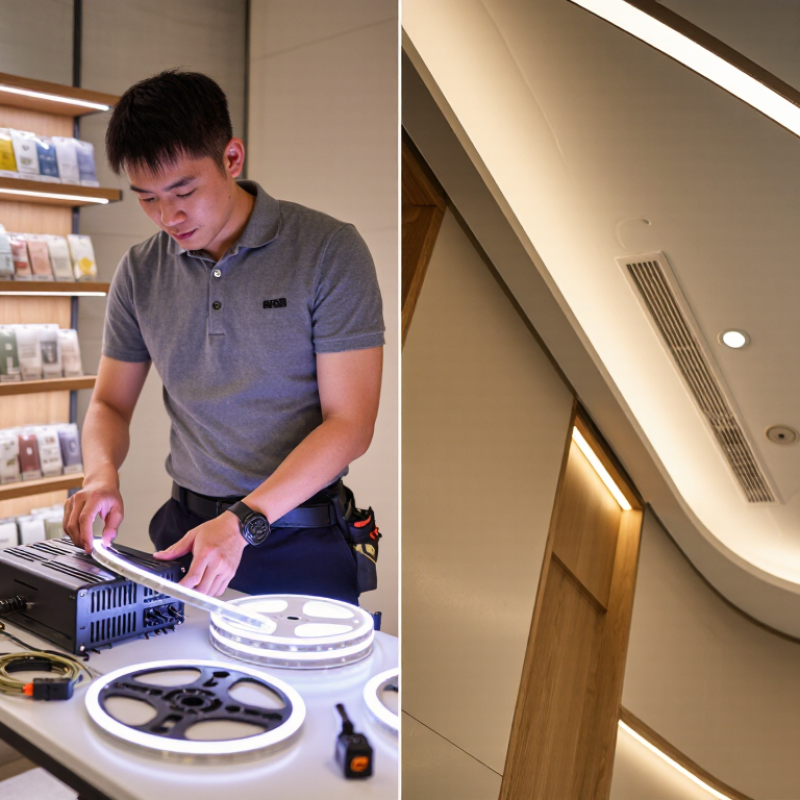
Before ordering in volume, measure the run, confirm the power supply plan, and request a sample when possible. Test it in the intended space, not only under warehouse lighting. Look for consistent color along the strip and across separate batches. Ask the supplier for clear technical data and warranty terms, then keep those details with the project records. I have seen a specification sheet look reassuring while the installed light felt too harsh. That is worth remembering. A practical choice balances visual comfort, reliability, serviceability, and budget, rather than chasing one impressive number.
Measure light output in lm/m and efficacy in lm/W before comparing strips
Before comparing LED strips, check luminous output in lumens per meter (lm/m), not just total lumens. This figure shows how much light each meter produces, making different strip lengths easier to compare. For a five-meter display shelf, a rating of 900 lm/m means about 4,500 lumens before installation losses. Numbers need context. Confirm that the stated output applies to the full strip, not a short test sample.
Then compare efficacy in lumens per watt (lm/W). It indicates how efficiently a strip converts electrical power into visible light. A strip producing 900 lm/m at 9 W/m has an efficacy of 100 lm/W. Higher efficacy can reduce energy use when you need similar brightness. Still, lm/W does not tell you whether the light suits your products or workspace. Heat changes things. In a tight aluminum channel, poor heat dissipation may affect long-term output.
Ask for test data that identifies operating voltage, color temperature, and measurement conditions. Check whether output is measured at the strip’s rated power and after it reaches a stable temperature. Compare color rendering and dimming performance too, especially for retail displays. A high lm/m figure may look attractive on paper, but excessive brightness can cause glare. I would not choose by one number alone; a small sample installed in the actual space can reveal issues a specification sheet misses.
Screen color quality with CRI Ra ≥80 and a suitable correlated color temperature
For retail displays, hospitality spaces, and work areas, color quality affects how products and materials appear. Choose LED strips with a general color rendering index, CRI Ra, of at least 80. ENERGY STAR’s lamp criteria also use CRI 80 as a baseline, though this benchmark does not guarantee identical results across products. Check samples beside familiar items: a red fabric, a wood finish, or printed packaging can reveal dull or shifted colors quickly.
CRI is useful, but it is a blunt instrument. The Illuminating Engineering Society’s TM-30-20 method evaluates 99 color samples, while traditional CRI Ra uses eight general samples. Ask suppliers for TM-30 data, including fidelity (Rf) and gamut (Rg), when color-critical work matters. A high Ra alone may not show how saturated reds will look.
Choose correlated color temperature (CCT) for the space, then keep it consistent across connected strips. Warm white, around 2700–3000 K, can suit relaxed dining areas; 3500–4000 K often feels more neutral for shops and offices. Cooler light can make some merchandise look crisp, yet it may feel stark on skin or warm materials. Test a short section in the actual room before ordering a full run. Small differences become obvious.
Match environmental protection to IEC 60529 IP ratings, such as IP65 for water jets
Choosing an LED strip for a business starts with the actual exposure, not the biggest IP number. IEC 60529 classifies protection against solids and water; each digit refers to a different test. IP65 is dust-tight and resists water jets from any direction under defined conditions. That can suit sheltered outdoor signs or areas cleaned with light jets. Not immersion.
An IP65 rating does not mean a strip can sit underwater, withstand every pressure washer, or resist cleaning chemicals. Check the specified test conditions and product documentation before installation. Inspect connectors, cut ends, splices, and power supplies too. A protected strip can still fail at an exposed joint. Small details matter.
Match the rating to the site. Indoor dry displays may need less protection, while direct rain or cleaning jets call for suitable water protection. Ask for test evidence for the complete assembly, not only the flexible strip. Mounting channels and drainage can change how water reaches it. One overlooked seam can undo a careful choice. Recheck the cleaning method with the facilities team; it is easy to underestimate how often water reaches the installation.
How to Choose High-Quality LED Light Strips for Your Business
Compare common IEC 60529 ingress protection ratings. For example, IP65 is dust-tight and tested against water jets.
The first IP digit indicates protection against access and solid objects; the second indicates water protection. IPX4 covers splashing, IPX5 water jets, IPX6 powerful water jets, IPX7 temporary immersion, and IPX8 immersion under conditions agreed between the manufacturer and user. These are distinct test classifications, not a single performance score; select a rating that matches the installation environment.
Check voltage, wattage, and run length; 24 V strips generally reduce voltage drop versus 12 V ones
For a business installation, check the strip’s voltage, wattage per metre, and recommended maximum run length before ordering. A 24 V strip often has less voltage drop than a comparable 12 V strip. At equal power, it draws about half the current, which can reduce losses along the cable and strip. Still, 24 V does not make every run unlimited.
Measure the actual route, including turns and gaps between sections. Multiply the strip’s wattage per metre by the total length to estimate the load. For example, a 5 m strip rated at 10 W per metre needs about 50 W. Choose a power supply that meets the manufacturer’s requirements and leaves suitable capacity for reliable operation. Check cable size, too; thin wires over a long distance can cause dimming.
Look for voltage-drop guidance in the product specifications, then test a sample at the far end of the planned run. Compare brightness near the power connection and at the last section. Small details matter. If brightness differs, shorten the run or add a power feed as permitted by the installation instructions. I have seen layout plans look tidy on paper, yet corner connections and long cable paths change the result. Measure twice.