
What Are China Top Exterior LED Strip Light Manufacturers?
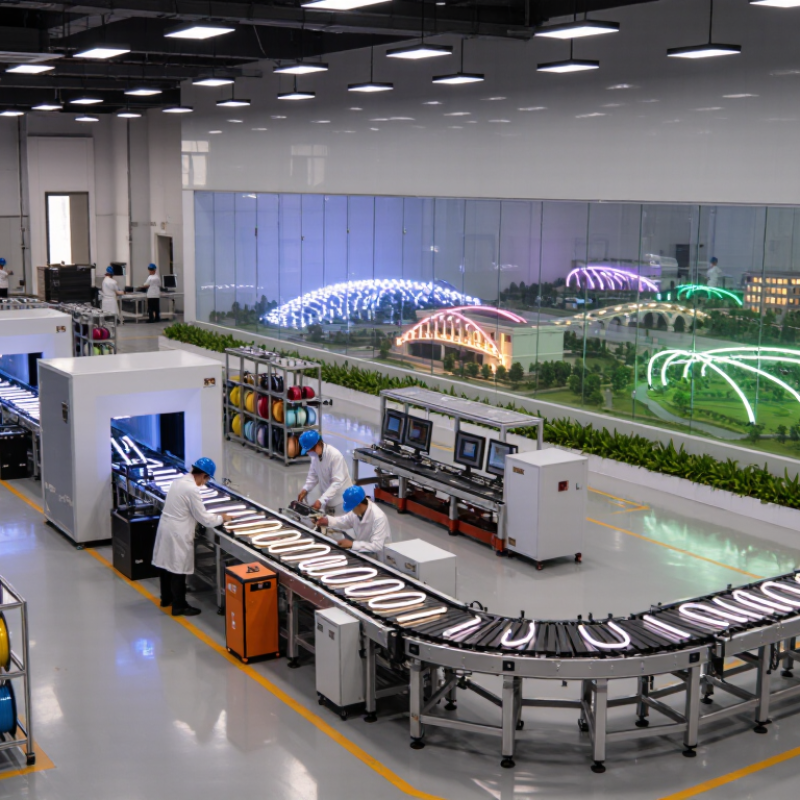
China has become a major production base for Exterior Led Strip Light products. Its factories serve gardens, façades, hotels, bridges, and commercial landscapes worldwide. However, “top” should not mean the largest exporter alone. It should reflect tested quality, engineering capability, customization, and dependable after-sales support.
Industry data supports this market’s continued development. The International Energy Agency reports that LED lighting offers substantial energy savings compared with conventional lighting. Grand View Research also identifies outdoor and architectural lighting as important growth areas within the broader LED industry. These reports do not rank Chinese strip light manufacturers directly. They provide useful market context, but product-level verification remains essential.
This article evaluates leading Chinese suppliers through practical criteria. These include IP65, IP67, or IP68 protection; stable color consistency; thermal management; flexible PCB quality; and long-term outdoor durability. Factory audits, sample testing, photometric files, and warranty terms deserve close attention. Certifications such as CE, RoHS, and relevant IEC compliance can strengthen supplier credibility. Yet certificates alone are not enough. A beautiful showroom may hide inconsistent soldering or weak adhesive performance.
Real experience matters.
Outdoor testing should examine water exposure, ultraviolet radiation, temperature changes, and continuous operation. Buyers should also review LM-80 data when applicable, along with clear binning and control-system specifications. This guide compares manufacturers using publicly available information, technical evidence, and purchasing considerations. The ranking may still require reflection, because supplier capabilities can change quickly. A responsible buyer should request current samples before approving any large project.
Definition and Key Features of Exterior LED Strip Lights
What Are China Top Exterior LED Strip Light Manufacturers?
Definition and Key Features of Exterior LED Strip Lights
Exterior LED strip lights are flexible lighting systems designed for façades, gardens, balconies, signs, and outdoor pathways. They use closely spaced LEDs on a circuit board, protected by silicone or another weather-resistant coating. Unlike indoor strips, exterior models must handle rain, dust, sunlight, temperature changes, and physical contact.
Reliable manufacturers usually provide clear IP ratings, tested voltage options, stable brightness, and consistent color temperature. IP65 may resist water spray, while IP67 offers stronger protection against temporary immersion. However, the rating applies only when connectors, end caps, and cable joints are sealed correctly. I have seen installations fail because the strip was rated well, but the connections were left exposed. No strip is perfect.
Tips: Check the IP rating for the actual location, not only the product page. Choose UV-resistant materials for direct sunlight. Use aluminum channels to reduce heat and improve straightness. Confirm cutting intervals before installation. Outdoor adhesive alone often weakens after repeated rain and heat. A qualified manufacturer should also explain power calculations, warranty conditions, photometric data, and safety testing. Ask for samples. Compare them after several hours of operation, because early brightness can be misleading.
| Evaluation Dimension | Recommended Specification or Standard | Definition and Key Features | Why It Matters for Exterior Applications |
|---|---|---|---|
| Product Definition | Flexible linear LED lighting for outdoor use | An exterior LED strip light is a flexible circuit board populated with light-emitting diodes and protected by a weather-resistant coating, housing, or extrusion. | It provides continuous decorative or functional illumination for façades, signs, landscapes, railings, canopies, and architectural structures. |
| Ingress Protection | IP65, IP67, or IP68 | IP65 protects against water jets; IP67 provides temporary protection against immersion; IP68 is designed for continuous immersion under manufacturer-defined conditions. | The correct rating helps protect the strip from rain, splashing, dust, humidity, and, where applicable, submerged installation. |
| Operating Voltage | 12 V DC or 24 V DC | Low-voltage direct-current systems are commonly used for flexible LED strips. A 24 V system generally reduces voltage drop over longer runs compared with a 12 V system. | A suitable voltage improves safety, installation reliability, and brightness consistency across the length of the strip. |
| LED Density | 30–120 LEDs per meter | LED density describes the number of LEDs installed on each meter. Higher density usually produces smoother and more uniform illumination. | High-density versions are preferable for continuous lines of light, while lower-density versions may be suitable for indirect or decorative lighting. |
| Color Temperature | 2,700–6,500 K | Warm white is generally around 2,700–3,000 K, neutral white around 3,500–4,100 K, and cool white around 5,000–6,500 K. | Color temperature affects the visual appearance of buildings, landscapes, signage, and public spaces. |
| Color Options | Single-color, tunable white, RGB, or RGBW | Single-color strips provide one fixed color. Tunable-white products adjust between warm and cool white. RGB products mix red, green, and blue, while RGBW adds a dedicated white LED channel. | The required color system depends on whether the project needs fixed illumination, adjustable ambience, or programmable color effects. |
| Color Rendering | CRI 80+; CRI 90+ for visual-quality projects | The Color Rendering Index indicates how naturally a light source reveals colors compared with a reference light source. | Higher CRI is useful for hospitality, retail, residential, landscaping, and architectural projects where material colors must appear natural. |
| Power Consumption | Approximately 4.8–19.2 W per meter | Power consumption varies according to LED type, density, brightness, color mode, and operating voltage. Actual values should be confirmed on the product specification sheet. | Accurate wattage is required for selecting the power supply, calculating energy use, and preventing circuit overload. |
| Cutting Interval | Commonly 25–100 mm | The cutting interval is the marked distance at which the strip can be safely shortened without damaging the remaining circuit. | Shorter cutting intervals provide greater flexibility for corners, signs, niches, and irregular architectural dimensions. |
| Maximum Continuous Run | Typically 5–10 m per power feed | The allowable run length depends on voltage, power rating, conductor design, LED density, and the manufacturer's wiring recommendations. | Respecting the recommended run length helps minimize voltage drop, uneven brightness, and excessive heat. |
| Operating Temperature | Commonly −20 °C to +45 °C | The operating range defines the ambient temperature in which the strip can function reliably. The exact range varies by construction and encapsulation material. | Temperature performance is important for exposed façades, cold climates, rooftop installations, and areas with high summer temperatures. |
| Thermal Management | Aluminum profile recommended | An aluminum channel or heat sink transfers heat away from the LED strip and can also improve mechanical protection and light diffusion. | Better heat dissipation can support longer service life, stable brightness, and more reliable operation in high-output installations. |
| Encapsulation Material | Silicone or weather-resistant polymer | Protective materials may be used as a coating, sleeve, or extrusion-compatible layer. Silicone generally offers good flexibility and resistance to ultraviolet exposure. | Material selection affects flexibility, yellowing resistance, sealing performance, bendability, and long-term outdoor durability. |
| UV and Weather Resistance | UV-resistant construction with sealed connections | Exterior products should use materials and end caps designed to resist sunlight, moisture, temperature changes, and environmental contamination. | Weather resistance reduces cracking, discoloration, water ingress, and premature failure during long-term outdoor use. |
| Dimming and Control | PWM, 0–10 V, DMX, DALI, or wireless control | Control compatibility depends on the strip type, controller, driver, and project control system. Addressable strips require data-compatible controllers. | The correct control method enables brightness adjustment, color changing, scene programming, synchronization, and automation. |
| Power Supply Selection | Same output voltage with 10–20% reserve capacity | The power supply should match the strip voltage and provide sufficient wattage for the total connected load plus an appropriate operating reserve. | Correct sizing improves stability and reduces the risk of overheating, flicker, nuisance shutdowns, and shortened component life. |
| Installation Method | Adhesive backing, mounting clips, or aluminum channels | Adhesive backing is convenient for clean, smooth surfaces, while clips and channels provide stronger mechanical support for demanding outdoor conditions. | A suitable mounting method prevents sagging, detachment, water accumulation, and damage caused by wind, vibration, or surface movement. |
| Safety and Compliance | Applicable electrical and photobiological safety documentation | Professional suppliers should provide technical datasheets, wiring diagrams, electrical test information, and compliance documentation relevant to the target market. | Documented compliance supports safer procurement, project approval, inspection, and installation by qualified personnel. |
| Quality Indicators for Supplier Evaluation | Consistent binning, verified specifications, sample testing, and warranty terms | A reliable manufacturer should demonstrate consistent color and brightness, accurate electrical data, stable production quality, and clear after-sales support. | These indicators help buyers compare exterior LED strip light suppliers without relying solely on price or promotional claims. |
Related Posts
-
Advantages of Utilizing Cool White LED Strip Lights for Your Business
-
The Future of Best Trimmable Led Strip Lights Shaping Smart Lighting Solutions Worldwide
-
Top Exterior LED Strip Lights for Outdoor Lighting?
-
What is Exterior LED Strip Light? Benefits, Types & Industry Insights 2023
-
Top 10 Cool White LED Strip Light Manufacturers from China at the 137th Canton Fair
-
How to Choose the Best Exterior Led Strip Light for Your Needs?