What Are the Best LED Lights Lamp Suppliers in China?
Choosing among the best Led Lights Lamp suppliers in China requires more than comparing catalog prices. A bright sample can hide weak thermal design, unstable color output, or poor after-sales support. Real sourcing experience matters. Buyers should inspect factory capabilities, request test reports, and compare samples under identical conditions.
Shuji Nakamura, a Nobel Prize-winning LED pioneer, once explained, “I wanted to make a blue LED because I thought it would be a big market.” His words reflect the importance of innovation behind modern lighting. Today, dependable suppliers should demonstrate more than marketing claims. Look for measurable lumen output, CRI performance, CCT consistency, heat dissipation, driver quality, and suitable IP protection. Reports such as LM-80 and TM-21 can support evaluation, but paperwork alone is not proof.
Small details matter. Check solder joints, cable strength, housing thickness, and packaging before placing a large order. Ask whether the quoted warranty covers actual failures, not only manufacturing defects. Verify certifications for the target market, because requirements vary by country. Factory videos can help, but an independent audit is stronger evidence.
No supplier is perfect.
Even experienced buyers can miss hidden risks. A low price may later become expensive through replacements, delays, or inconsistent batches. This guide examines leading Chinese Led Lights Lamp suppliers through product quality, customization, production capacity, communication, compliance, and reliability. The goal is not to praise the biggest name, but to identify partners that can perform consistently after the first shipment.
How China’s LED Supply Chain Covers Chips, Drivers, and Finished Lamps
What Are the Best LED Lights Lamp Suppliers in China?
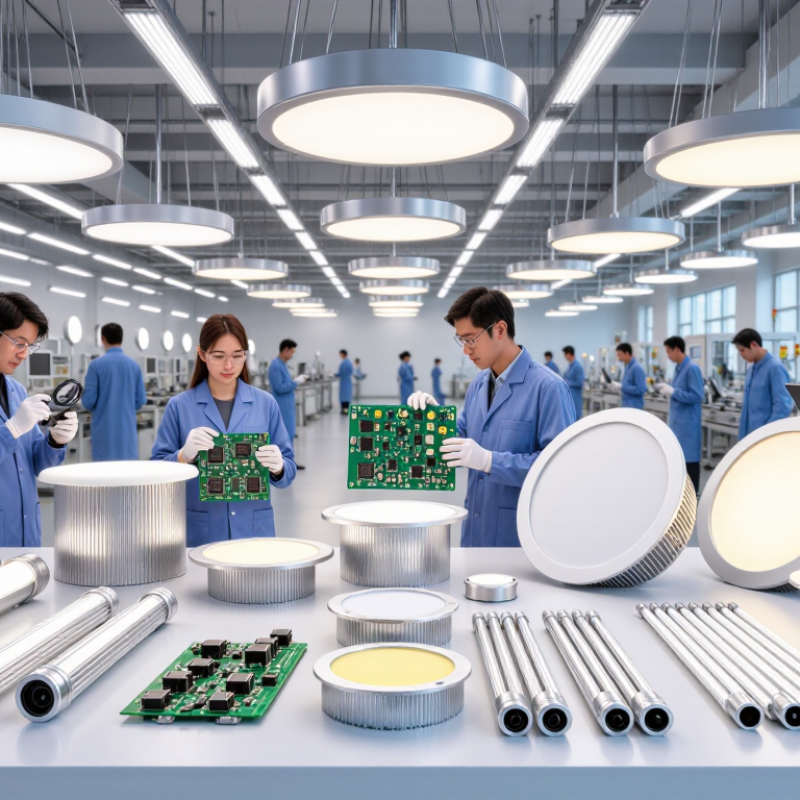
China’s LED supply chain covers more than finished lamps. It includes chip epitaxy, wafer processing, LED packaging, driver production, and final assembly. This depth helps suppliers control cost and customize products. The International Energy Agency reported that LEDs represented about half of global lighting sales in 2022. The U.S. Department of Energy also continues to record major gains in LED efficacy and product life.
Reliable suppliers usually show technical evidence, not only attractive catalogs. Ask for chip binning data, driver efficiency, power-factor results, and flicker measurements. A serious factory should explain its thermal design clearly. Inspectors can check solder joints, lens alignment, insulation, and heat-sink contact during sampling. For export projects, request reports based on applicable IEC standards and market requirements. Certification alone is not enough. I have seen compliant-looking samples perform poorly after long thermal cycling. That mistake is easy to miss.
Tips: Compare samples at the same wattage and color temperature. Measure light output after one hour, not immediately. Check driver noise, startup time, and dimming behavior. Ask whether key components change between batches. The lowest quote may hide weaker capacitors or inconsistent chips. A supplier’s response to difficult questions often reveals more than its brochure. Use independent testing when the project involves large volumes or public installations.
Screening Suppliers with LM-80, TM-21, and ≥80 CRI Performance Data
What Are the Best LED Lights Lamp Suppliers in China?
China has many LED lamp suppliers, but a catalog rarely proves long-term performance. Screening should begin with evidence, not lumen claims. LM-80 reports measure lumen maintenance for LED packages or modules under defined temperatures and drive currents. TM-21 uses that data to project lumen maintenance over time. Neither document automatically represents a complete lamp. The U.S. Department of Energy’s solid-state lighting guidance separates component testing from system performance. That distinction matters.
The International Energy Agency reported that LED products exceeded half of global lighting sales in recent years. This growth makes supplier screening more important, not less. Request original LM-80 files, test laboratory details, sample numbers, and operating conditions. Check whether testing covers at least 6,000 hours, with regular measurement intervals. Review the TM-21 calculation, projected hours, and temperature limits carefully. A TM-21 projection is not a lifetime guarantee. It is an estimate based on available data. For color quality, require CRI of at least 80, supported by test results under the actual lamp’s operating conditions. Also check R9, color consistency, and temperature drift. A clean spreadsheet can still hide weak assumptions.
Tips: Verify the model number across every document. Ask for measured case temperature, input current, power factor, and warranty terms. An accredited laboratory report is stronger than a supplier-created table. One audit lesson is easy to miss: impressive data may describe a component, not the finished lamp.
Comparing 100–200 lm/W Efficacy and 25,000–50,000-Hour Lifespan
When evaluating LED lamp suppliers in China, efficacy and lifespan deserve more than catalogue figures. A quoted 100–200 lm/W range can describe different products, drive currents, or laboratory conditions. Ask for test reports showing lumen output, power draw, color temperature, and ambient temperature. A 150 lm/W lamp at 25°C may perform differently inside a sealed outdoor housing. Small details matter.
For lifespan, 25,000–50,000 hours is a useful comparison, not a promise of endless operation. LEDs may remain lit while producing noticeably less light. Request lumen-maintenance data, such as L70 projections, and check whether testing follows recognized LM-80 and TM-21 methods. Also examine the driver, thermal path, and capacitor quality. In practical installations, heat is often the quiet failure point. A supplier with traceable records should explain its test equipment, sampling method, and warranty terms without vague language.
I would compare samples under the same voltage and operating time before placing a large order. Measure illumination with a calibrated meter, then inspect flicker, heat buildup, and color consistency after several days. It is not perfect. Small batches can hide production variation. Ask for independent verification when the claimed 200 lm/W seems unusually high. Suppliers that disclose limitations usually inspire more confidence than those promising maximum efficiency everywhere. The best choice balances measured output, thermal design, stable quality, and realistic service life.
Verifying CE, RoHS, UL, and ISO 9001 Certifications
Choosing the best LED lamp supplier in China requires more than comparing prices and wattage. Certification documents should match the exact product, factory, and electrical design. CE marking indicates conformity with applicable European requirements, but it is not always an independent safety certificate. Ask for the Declaration of Conformity and related test reports. RoHS evidence should confirm restricted substances in the lamp, driver, cable, and solder. Check the report date and product model carefully.
For UL-marked products, request the listing number and verify it through the official certification database. The file should cover the complete lamp, not only one internal component. ISO 9001 shows that a supplier operates a quality management system. However, it does not prove that every lamp is safe or durable. A certificate can be valid while factory controls remain inconsistent. That gap deserves attention.
Tips: Compare the certificate holder with the supplier’s legal company name. Confirm the factory address. Request a production sample with the same model code shown in the documents. Inspect labels, driver markings, wiring, and packaging. Independent laboratory testing is useful for large orders. It costs more, but it may reveal overheating, weak insulation, or unstable light output. Documents can look convincing. Physical evidence is better.
What Are the Best LED Lights Lamp Suppliers in China? - Verifying CE, RoHS, UL, and ISO 9001 Certifications
| Certification or Verification Area | What It Confirms | Authentic Evidence to Request | Key Details to Match | Recommended Verification Method | Supplier Review Status |
|---|---|---|---|---|---|
| CE Marking | Indicates that the product is declared to meet applicable European Union health, safety, and environmental requirements. | EU Declaration of Conformity, technical documentation, test reports, and product identification records. | Exact model number, rated voltage, frequency, product category, applicable directives, and declaration date. | Check the Declaration of Conformity against the product label and verify whether third-party testing is required for the applicable product category. | Supplier-specific verification required |
| RoHS Compliance | Shows that restricted substances in electrical and electronic equipment are within applicable limits. | Material declaration, laboratory test report, supplier declarations, and technical file references. | Reference to Directive 2011/65/EU and applicable amendment requirements, including ten restricted substances under current EU RoHS provisions. | Confirm that the report covers the supplied model and major components such as LED modules, drivers, housings, cables, and soldered assemblies. | Supplier-specific verification required |
| UL Certification | Demonstrates that a product or component has been evaluated against specified safety requirements under an applicable certification program. | Certification file number, product category, certification mark information, and applicable safety standard. | Model designation, construction details, electrical ratings, certification scope, and whether the approval covers the complete lamp or only a component. | Search the certification file in the official UL Product iQ database using the file number or model information. | Supplier-specific verification required |
| ISO 9001:2015 | Confirms that the organization operates a quality management system assessed against ISO 9001 requirements. | Current certificate issued by an accredited certification body, certificate number, scope statement, and audit dates. | Legal entity name, manufacturing site address, certificate validity period, and scope covering LED lighting design or production where applicable. | Verify the certificate with the issuing certification body or its public certificate database and confirm accreditation status. | Supplier-specific verification required |
| Electrical Safety Testing | Assesses protection against electric shock, abnormal operation, overheating, insulation failure, and related hazards. | Complete test report from a competent laboratory and product construction description. | Input voltage, frequency, protection class, ingress protection rating, lamp type, driver type, and tested configuration. | Compare the tested sample and model number with the production specification and purchase order. | Review before approval |
| Photobiological Safety | Evaluates potential optical radiation risks from LED light sources, including blue-light exposure classification where applicable. | Photobiological safety test report and risk-group classification. | LED light source type, optical output, test distance, operating condition, and product classification. | Confirm that the report applies to the finished luminaire rather than only to an individual LED package. | Review before approval |
| Performance and Energy Data | Provides measurable information about light output, efficiency, color characteristics, power consumption, and operating life. | Independent photometric report, electrical test data, LM-80 or equivalent LED-package data where relevant, and warranty terms. | Luminous flux, efficacy, color temperature, color rendering index, power factor, total harmonic distortion, rated life, and ambient temperature. | Require test conditions and tolerances; compare samples from different production batches. | Sample testing recommended |
| Factory Quality Controls | Indicates whether the supplier has repeatable controls for incoming materials, assembly, testing, traceability, and final inspection. | Quality manual, inspection records, calibration records, corrective-action reports, and process-control documents. | Incoming inspection, driver testing, aging test, electrical safety test, labeling control, batch traceability, and final inspection criteria. | Conduct a factory audit or appoint an independent inspection agency before mass production. | On-site or third-party audit recommended |
| Certificate and Document Control | Reduces the risk of expired, altered, incomplete, or mismatched certification documents. | Controlled document list, revision history, certificate renewal records, and authorized signatory details. | Document version, issue date, expiration date, issuing organization, factory location, and product scope. | Recheck documents before shipment and whenever the LED module, driver, housing, or manufacturing site changes. | Continuous monitoring required |
Selecting Suppliers by MOQ, Lead Time, Warranty, and Total Cost of Ownership
What Are the Best LED Lights Lamp Suppliers in China?
Choosing an LED lamp supplier requires more than comparing catalog prices. MOQ, lead time, warranty, and total cost of ownership can change the real value significantly. A supplier accepting a small MOQ may suit product testing, while larger orders usually reduce unit costs. Ask for a written production schedule, not only a sales promise. Confirm sample approval, packaging details, and inspection dates before placing an order. Delays can damage seasonal sales. They happen.
A reliable supplier should explain its warranty terms clearly. Check coverage for drivers, LED chips, housing, and lumen depreciation. Request test reports, factory audit records, and recent quality data. Samples should run continuously for several days under realistic temperatures. I once treated a low quote as a saving, but replacement parts and freight erased the advantage. Calculate energy use, maintenance, failure rates, shipping, duties, and disposal costs across the expected service life. That is total cost of ownership, not merely the invoice price. Some estimates remain uncertain, so record every assumption.
Tips: Compare at least three written quotations. Set acceptance standards for brightness, color consistency, power factor, and packaging damage. Negotiate a practical MOQ based on your sales forecast, not optimism. Ask whether spare units are included. Keep warranty claims, response times, and replacement responsibilities in the contract. A supplier with a slightly higher price may offer steadier lead times and fewer service problems. Recheck the numbers before scaling.
What Are the Best LED Light Suppliers in China?
Supplier selection benchmark based on MOQ flexibility, standard lead time, warranty coverage, and modeled three-year total cost of ownership.
Scores are normalized planning benchmarks: a higher score indicates a more favorable procurement position. MOQ flexibility favors lower minimum order quantities, lead-time performance favors shorter standard production cycles, warranty coverage is measured against a five-year reference, and TCO combines purchase, freight, energy, maintenance, and replacement costs over three years. Confirm all figures through a supplier RFQ.
Related Posts
-
Transform Your Space: The Magic of Wide LED Strip Lights for Home Decoration
-
Top 2025 Trends in Led Lights for Home and Business Lighting Solutions
-
How to Choose the Best Bright Led Lamp for Your Needs?
-
Challenges Faced with Bright Led Lamp Procurement
-
What is Trimmable Led Strip Lights and How to Use Them?
-
Maximizing Value with Small Led Bulb After Sales Support and Maintenance Efficiency